Tamil Nadu Census 2011 - recommended for TNPSC Preliminary Examination
|
Category
|
2011
|
|
Population
|
7,21,38,958 (37.19R + 34.95U)
|
|
Sex Ratio
|
995
|
|
Child Population
|
6.89 million / 68.9 L
|
|
Child sex ratio
|
946
|
|
Literates
|
52.41 million/ 5.241 Crore
|
|
Literacy rate
|
80.33
|
|
Rural Population growth
|
2.27 million (absolute)
|
|
Urban Population growth
|
7.47 million (absolute)
|
|
Districts
|
32
|
|
Sub-Districts
|
215
|
|
Towns
|
1097
|
|
Villages
|
15979
|
1.
Largest
Rural Population – Villupuram (7.94%
of state rural population)
2.
Highest
Urban Population – Chennai (13.39%
of state urban population)
3.
Decade
growth rate in population in rural and urban – 6.49% & 27.16% (TN overall –
15.60%)
4.
Decade
growth rate highest in rural – Villupuram
district (16.58%)
5.
Decade
growth rate lowest in rural – Kanyakumari
district (-43.89%)
6.
Decade
growth rate highest in urban – Kancheepuram
district (65.33%)
7.
Decade
growth rate lowest in urban – Nilgiri
district (-4.09%)
8.
Proportion
of rural and urban population – 51.55% and 48.45% (increase of 4.41%)
9.
Largest
proportion of rural population – Ariyalur
(88.88%)
10.
Largest
proportion of urban population – Kanyakumari
(82.47%) – (apart from Chennai which is totally urban)
11.
Sex ratio –
995 (987 in 2001); increase in rural by 1 point to 993 and increase in urban by
16 points to 998.
12.
Highest sex
ratio – Nilgiri district (1041);
Rural – Nilgiri district (1055);
Urban – Thanjavur district (1038).
13.
Lowest sex
ratio – 1. Salem (934), 2. Ramanathapuram (960)
14.
Child
population (0-6 years) – declined in rural (-13.73%) and grown in urban
(+8.02%) (Note : decline in child population means decline in fertility, which
shows that the stage is in 3rd stage of demographic transition)
15.
Child sex
ratio – 946 (942 in 2001); Rural -937(933 in 2001) and Urban – 957(955 in
2001).
16.
Rural child
ratio – Niligiri (highest -979); Cuddalore (lowest – 878)
17.
Urban child
ratio – Nilgiri (highest – 984); Ariyalur (lowest – 908)
18.
Highest
number of rural literate – Villupuram;
Highest number of urban literate – Chennai
followed by Coimbatore.
19.
Literacy
rate - Male literacy rate – 86.81 ( R-82.08,
U-91.82); Female literacy rate – 73.86 (R-65.52, U-82.67)
20.
Highest
literacy rate in urban and rural – Kanyakumari
district (R-90.95; U-92.40)
21.
Lowest
literacy rate in urban and rural – Dharmapuri
district (R-62.69; U-74.43)
22.
Highest male literacy rate in rural – Kanyakumari (92.49)
23.
Highest male
literacy rate in urban – Pudukottai and
Sivaganga (94.17)
24.
Lowest male
literacy in urban and rural – Dharmapuri
(R-67.30, U-78.17)
25.
Lowest
female literacy rate in rural – Salem
(56.71)
26.
Lowest
female literacy rate in urban – Dharmapuri
(70.25)
27.
More
Villages in – Villupuram district (1486); Less in Nilgiri (40)
28.
No if
sub-districts more in – Tirunelveli and Pudukottai (11 each)
29.
No of
statutory towns more in – Kanyakumari district
30.
No of census
towns more in – Kancheepuram district
Summary of above in tabular format
*denotes excluding Chennai. Means
Chennai is the highest or lowest and the mentioned is the next to it. B in sex denotes both.
|
Sex
|
Category
|
Highest
|
Lowest
|
|
B
|
Population
|
Kancheepuram*
|
Nilgiri
|
|
B
|
Rural Population
|
Villupuram
|
Nilgiri
|
|
B
|
Urban Population
|
Coimbatore*
|
Ariyalur
|
|
B
|
Decade growth rate in urban
|
Kancheepuram
|
Nilgiri
|
|
B
|
Decade growth rate in rural
|
Villupuram
|
Kanyakumari
|
|
B
|
Proportion of rural population
|
Ariyalur
|
Kanyakumari
|
|
B
|
Proportion of urban population
|
Kanyakumari
|
Ariyalur
|
|
-
|
Sex Ratio
|
Nilgiri
|
Salem
|
|
-
|
Rural Sex ratio
|
Nilgiri
|
Salem
|
|
-
|
Urban Sex ratio
|
Thanjavur
|
Krishnagiri
|
|
-
|
Child Sex ratio
|
Nilgiri
|
Ariyalur
|
|
-
|
Rural child sex ratio
|
Nilgiri
|
Cuddalore
|
|
-
|
Urban child sex ratio
|
Nilgiri
|
Ariyalur
|
|
B
|
Child Population
|
Vellore*
|
Perambalur
|
|
B
|
Rural Child Population
|
Villupuram
|
Nilgiri
|
|
B
|
Urban Child Population
|
Kancheepuram*
|
Ariyalur
|
|
B
|
Decade child population growth
|
Kancheepuram
|
Nilgiri
|
|
B
|
Decade rural child population growth
|
Villupuram
|
Kanyakumari
|
|
B
|
Decade urban child population growth
|
Kancheepuram
|
Nilgiri
|
|
B
|
Highest rural literates
|
Villupuram
|
Nilgiris
|
|
B
|
Highest Urban literates
|
Chennai
|
Ariyalur
|
|
R+U
|
Literacy Rate
|
Kaniyakumari
|
Dharmapuri
|
|
-
|
Male Literacy Rate - Rural
|
Kaniyakumari
|
Dharmapuri
|
|
-
|
Male Literacy rate - Urban
|
Sivanganga & Pudukottai
|
Dharmapuri
|
|
-
|
Female Literacy rate- rural
|
Kanyakumari
|
Salem
|
|
-
|
Female literacy rate - urban
|
Kanyakumari
|
Dharmapuri
|
World History for General Studies (Paper -1) by Ravi Shankar - Is it worth buying for Main Examination preparation?
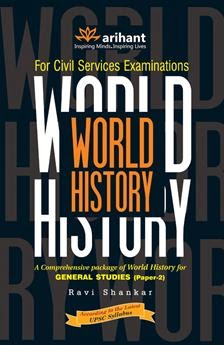
Civil Service Main Examination 2013 is concluded, now the candidates have some clear cut idea about how and from where the questions are asked. Before the examination many new books were coming in the market just like the mushroom during the raining season. Not all mushroom's are good and the same is applicable to study materials too. I came across a book which claims that it is a comprehensive package world history in General studies paper-1. Is it worth buying? I am here to provide you with a critical review of the book, considering the quality of its contents, way of presentation, correlation with prescribed syllabus and of course a comparison with the main examination question paper.
About the book
Publication : Arihant
Author : Ravi Shankar
Edition : First Edition, 2013
Price : MRP 150
General Studies (Paper:1) - Main Examination Syllabus (World History)
History of the world will include events from 18th century such as industrial revolution, world wars, redrawal of national boundaries, colonization, decolonization, political philosophies like communism, capitalism, socialism etc, - their forms and effect on the society
What contents does this book cover?
 Chapter 1 :Renaissance
Chapter 2 : American Revolution
Chapter 3 : French Revolution
Chapter 4 : Industrial Revolution
Chapter 5 : Unification of Italy and Germany.
Chapter 6 :Imperialism and Colonialism
Chapter 7 : Russian Revolution
Chapter 8 : World War 1
Chapter 9 :World War 2
Chapter 10: Political Philosophies in Modern World
Chapter 11 : Liberation from Colonial Rule
Chapter 12 : Post War Foundations : NATO and European Community
Chapter 13 : Fall of Soviet Union and USA's Domination
Important Historical Terms and Famous Personalities
Model Question - Answers
How many questions you would have attended in World history portion in the concluded main examination?
- Latecomer- Industrial revolution in Japan involved certain factors that were markedly different from what west had experience. - Not covered
- What policy instruments were deployed to contain the great economic depression? - Mock question at the end of the chapter has answer to this question directly.
- Africa was chopped into states artificially created by accident of European competition. Analyse. - Covered in Chapter 6: Imperialism and Colonialism.
- American Revolution was an economic revolt against mercantilism. Substantiate. - This question is almost picked from the model practice question provided at the end of each chapter. Here is the model question mentioned in the book, " The American Revolution was essentially as economic conflict between American capitalism as British Mercantilism."?
Positive Features
- Lucidly written in the format of notes.
- Covers almost all prominent part of the syllabus.
- Font is catchy and it draws interest to read.
- Practice questions after every chapter and mock questions with answers at the end of the book.
- Good quality paper
Drawback
- History of China, Japan, Vietnam are not covered extensively. In fact NCERT covers this area.
Over all it's a good buy for World History portion of main examination. Of course NCERT too covers these areas. The topics covered will also be useful in tackling objective questions in other competitive examinations (IB, SSC CGL etc,) too.
Where to Buy
- Flipkart - Rs.105(30% off) - To buy click here
- Arihant Site - Rs. 127.50 (15% off)
How to prepare for IBPS PO Common interview? - Guidelines, Strategy and Mock Questions
Common Interview and Allotment date - Notification
IBPS Common Written Examination (CWE) is over and now it’s
time for the Common Interview. The official notification with respect to the common interview is
already released.
Still in Confusion whether your CWE score is sufficient? - Click Here to Get Confidence
- When does the interview start? – From January 2, 2014.
- When can I download my interview call letter? – From December 16, 2013.
- When does the allotment start? – From April, 2014 (provisional) as of now.
- What documents should I take to the interview? – refer the official notification, it is clearly mentioned.
IBPS Common Interview
 Once the IBPS score
card was out, I am sure one set of candidates would have already started
preparing for interview. Some candidates are still in confusion from where they
should start. Few candidates (first timers) are still thronging multiple blogs
and Facebook groups about what is the next step in the recruitment process. I
am sure you will be surprised, one candidate has scored 76 (UR) and questioned in
Yahoo Answers that she has passed the examination and she do know what will
happen next. She enquires whether any individual bank will call/mail her to
come to interview. Who knows this is also the reason (ignorance) that many
candidates in spite of scoring good fail to turn to interview. Let’s hope no candidate miss the common
interview, just because of ignorance.
Once the IBPS score
card was out, I am sure one set of candidates would have already started
preparing for interview. Some candidates are still in confusion from where they
should start. Few candidates (first timers) are still thronging multiple blogs
and Facebook groups about what is the next step in the recruitment process. I
am sure you will be surprised, one candidate has scored 76 (UR) and questioned in
Yahoo Answers that she has passed the examination and she do know what will
happen next. She enquires whether any individual bank will call/mail her to
come to interview. Who knows this is also the reason (ignorance) that many
candidates in spite of scoring good fail to turn to interview. Let’s hope no candidate miss the common
interview, just because of ignorance.What does the interview committee expect from you?
The number of members
in the interview committee or whether there will be uniform number of members
in the interview committee throughout the nation in all the centres is still
not known or either revealed. However the interview board will not have less
than 4 members. My first advice to dear readers(first timers) is that do not worry or panic
thinking about the number of members in an interview committee. In fact more
the members, less questions from every individual and good chance of escaping
from any single person who continues to ask tough/critical question.
Let us do an analysis before going into the actual topic.
Just ask a question to yourself? If you are the Chairman/ MD of a private bank
and you are sitting in the interview committee. Your bank is performing well
all these years and you are planning to widen your branches in more places. So
you need Officer’s for your branch. What do you expect from the candidates
appearing in the interview? Remember, choosing an inefficient person may
spoil your business.
- Will you hire a person who does not speak? – No, because you need your officers to engage themselves with customers. More you interact with your customers, more the business it brings.
- Will you hire a person who is not clear in what he is expressing? – No, because if you are loan manager or retail manager you need to express your views lucidly to your customers to make them understand it. It is finally you, who bring business to the bank. So the person hired should be good in expressing his views.
Continue to ask similar questions assuming that it is you
who own the bank, this is a process of self-learning and I am sure just this self-learning
and self-analysis will provide you with basic idea of how you should present
yourself.
Won’t they test my knowledge?
Yes of course they
do. But the personality test is not just about digging out your knowledge. It
is also to test your attitude, skills, confidence, creativity and ability to accomplish a task. So your interview basically has two components,
- To test your personality.
- To test you knowledge. ( conceptual understanding and in depth knowledge)
Testing your Personality?
When it comes to personality test, once should keep two
thumb rules in mind,
- “There is no right or wrong answer, it just matters how you answer”.
- “What is right for someone, may be wrong for you and what is wrong for others may be right for you”
What do they ask to test my personality? It is not necessary
that they should ask you question. Your sitting posture , way of answering, way
of dressing, the way you look them and the way you argue/counter argue your points
provides them the necessary clue about your personality. They evaluate your confidence level, inferiority/superiority complexes, ability to face problems, ability to find solutions, your attitude and so on without specifically asking any question, but
from the answers given by you to some general questions.
Let us see one by one,
What does my posture signify? - If you bent yourself with your arms and legs
crossed then it signifies that you are someone who is unfriendly and it is an
indication of antagonism. Amy Cuddy, professor and researcher in Harvard
Business School, reveals that these weak postures increase your cortisol level
and decrease your testosterone level. Higher Cortisol and lower testosterone
reduces your confidence level. Whereas if you sit straight, which she portrays
as strong pose, increases your confidence level by reducing the cortisol level
and increasing the testosterone level. So your sitting posture indirectly gives
them idea about your confidence level.
Do not say sorry often – During the course of interview, if
you fail to answer any questions or answered incorrectly, do say sorry and
suffix it by saying that you will learn/ correct it. But if you continuously
say sorry, it indirectly signifies your inferiority complex. Try to avoid the
word please too.
How to answer the questions? – The way you answer the
questions also gives an idea of your attitude. When a question is asked, first
listen to him fully before giving the answer. Do not interrupt and start answering
before the member completes the question. Answer the question clearly so that
the interview board understands what you wish to say. Remember, it doesn't matter what you say, it only matter’s what they understand. So make your
answers to the point asked expressing it clearly. Efficient answer gives them
an idea of your ability to express your views and communication skill.
Have a smile on your face – Try to have a smile (it doesn’t
meant you have to laugh loud or show your teeth). Just have a gentle smile in
your face, even if you fail to answer the question. It shows your issue solving
capability and ability to handle tensed situation.
Forget exclamatory remarks – Never use, ‘Oh My God’, ‘Shit’
or any other exclamatory words during the course of the interview when you do
something by mistake. Let your hands be in rest. Some people tend to keep their hands on their head or forehead when they commit mistake. If you are in this list, control your hand. Also while answering avoid hand actions.
Groom yourself properly – If you are a boy – have a clean
shave, proper haircut and present yourself appealing. Appealing doesn't mean
the way you dress to visit your girlfriend. You need look like a professional.
The reason is, customers usually have more belief in someone who is well
groomed. Also not being shaved or haircut signifies that you are lazy. It is
not necessary that you have to go with suit. You can go with formal wear
(preferable light shirts/ dark pant) and shoes. Wearing light coloured shirts
will look calm and pleasant, whereas dark colours may sometime irritate the one
who site opposite to you. (Source: Read somewhere long back, Google colour
psychology to learn a bit)
Inferiority/ Superiority complex- Both are dangerous. Never
try to exaggerate what you say nor stay without giving your opinion. Do not
talk too loud (shout) nor talk too low.
Dealing with counter argument: If you have difference of
opinion about anything with the committee member, you can politely say that you
have a difference of opinion and request him to permit you to say it. Do not
give your counter opinion without requesting. It will surely have a negative
impact if the committee member himself has some sort of superiority complex.
First Impression: This topic should have been mentioned
first, but I purposely kept it at the bottom to stress its importance. Usually
after interviewing a candidate, members take a minute or two to call the next
candidate. Just wait for your time to enter. Usually there will be a staff to
assist you. Even if you are asked to come in, gently open the door, request
cordially, “May I come in Sir’s/Madam” and wait until they ask you to take your
seat. Usually once you come near your seat, they immediately ask you to sit.
Say ‘Thank you’, sit with a strong pose with a smile on your face.
Some questions you should be ready to answer
I will just share the
questions, but not the answers as it violates rule 1 and 2 which I have already
mentioned. Let me put it again,
- “There is no right or wrong answer, it just matters how you answer”.
- “What is right for someone, may be wrong for you and what is wrong for other may be right for you”
In all these questions, do not give superstitious/
exaggerated answers; try to be honest and down to earth while answering. There
are few ready made answers available for all these questions provided by
coaching centers. Do not assume that the board members are fool. They can easily differentiate an honest and a naïve answer. Below are few common
questions which are generally asked in bank interviews. These questions are
basically not to test the knowledge, but to test your personality and your
attitude.
- Tell me about yourself?
- Why did you choose banking as your career?
- Why did you prefer banking though you are from Science/Engineering background? (If you are from Science or Engineering background)
- Are you preparing for any other competitive examinations?
- Why do you want shift your profession /company / career? (If you are already in job -Do not complain your past employer at any cost even if they are bad on you - Have a answer if the salary you get now is more than what you will be getting in bank after becoming PO)
- Did you choose banking just because of the lucrative salary or for so called white collar job?
- what did you do all these years after your graduation? (If you are jobless)
- Why did you give “XYZ” bank as your first preference? (Not often asked, but what if asked?)
Questions to test your creativity
- What difference can you bring after joining in a bank as PO?
- What new marketing strategy can you adopt to increase the business in your bank?
- Suggest some innovative ideas for financial inclusion?
- How can you market the need for credit cards in the present generation? (Other retail banking products too may asked in similar fashion).
- Other similar questions to study your skill and creativity.
Questions to test your knowledge
Your knowledge on
current happenings, concepts on banking, aptitude skill and computer awareness
were already tested through the written examination. But what is the proof that
you had better understanding of the concepts? In order to confirm this, few
questions usually of analyzing type are asked to trigger your thinking
capability. Sometimes direct questions too are asked, similar to what is asked
in written examination. But there is a
universal truth, if the questions continue to rise in difficulty, then you are
performing well. If the level of question has dropped from what is asked to you
before, then probably you did not satisfy them. Usually to make you comfort
(mostly) they start with some fundamental questions. What is IFSC code? Why it
is required? What is MICR code? Why it is required? How bank transactions are made? What is the
difference between NEFT and RTGS? What does it mean by priority sector lending?
These questions are like starter following your personality
questions which I mentioned previously after seeing your profile. Based on you
answers, level of questions may vary. Usually the questions get diverted from
your answer. Be careful when you mention any concept/ term. Probably your next
question will be the same. The same technique can be used to get the board
members to your comfort zone. For instance, if you have done quite a good
research in financial inclusion and have better ideas. Try to bring the concept
of financial inclusion when you answer a question. Give a slight stress and
expect the question from your comfort zone.
Topics to cover for the upcoming IBPS PO common interview
Let me share few
topics of importance which one need to cover before appearing in interview.
- Refine your basic knowledge on banking concepts and economic indicators. (Similar to what you prepared for written examination, but now enrich your knowledge in concepts so that you can answer all types of interrogations on these topics).
- New Banking Licence – Pros and Cons
- NPA in bank – what can be done and your opinion on steps taken by government to tackle the issue.
- What additional steps can be taken to improve security in ATM? (Remember the recent Bangalore tragedy.)
- Are internet banking / mobile banking / online transactions safe? How will you convince a customer about its safety and ease of use?
- What is your opinion about the RBI’s permission to permit WOS of foreign banks to acquire to domestic private banks? (Bank unions are going on strike against this decision on 18th December, so you can learn the pros by reading from RBI point of view and cons by reading the trade union point of view.)
- What is your opinion about the RBI decision to allow foreign bank subsidiaries to list in local stock exchange?
- What are the problems faced by farmers? Do you think Agriculture loan waiver has reached the targeted audience? What are the Government’s steps to tackle the issue? Give your suggestion? (Agriculture loan comes under priority sector lending, so one need to have idea about this.)
- What can be done to keep inflation under control?
- What is the reason for dollar price hike recently and the remedy taken?
- What is your opinion about the recent monetary policy changes by RBI? (Look at RBI site)
- Have a look at the sites which I will be mentioning and note for any new order/ policy etc., – RBI, Department of Financial Services, Ministry of Finance, SEBI, IRDA before going to interview.
- Also go through recent topics of discussion like - Food Security Bill, Cash Benefit Transfer, Mangalyan (why to spend 450 crores in Mars exploration when more than 70% of our people are still in poverty?) etc,
- Questions listed above are to give some basic idea. Candidates are asked to widen their knowledge conceptually in the recent topics of Economics and Current Affairs.
- Important topics related to banking which are not mentioned can be shared by experienced candidates. It will be helpful to first timers.
- I personally believe that one need to answer honestly to questions on his profile. However some coaching centres have ready made answers for it. What I have mentioned is my view, it is upto the candidates to decide.
"With Confidence You Have Won Before You Have Started" - Marcus Garvey
Subscribe to:
Posts
(
Atom
)